How do Belcaro and Bonnie Brae compare as South Denver neighborhoods?
Belcaro offers larger lots, more privacy, and larger homes in the $1.5M–$3M range. Bonnie Brae is more walkable with a neighborhood commercial strip, smaller lots, and entry-level homes from $700K. Both are established Denver neighborhoods with distinct buyer profiles and strong long-term appreciation.
Belcaro and Bonnie Brae sit within a few blocks of each other on Denver’s south side, and they are often mentioned in the same breath by buyers looking in that part of the city. They share the same general location, the same proximity to Cherry Creek, and the same character as established, mature neighborhoods that attract buyers who want something more distinctive than a suburb built on a master plan. But they are not the same neighborhood, and the differences shape who tends to end up in each one.
I have worked with buyers in both neighborhoods across two decades in Denver luxury real estate, and I want to give you an honest look at what makes each one distinct — not just the marketing language, but the actual experience of living there.
Where They Are and Why That Matters
Both neighborhoods are in southeast Denver, close to Colorado Boulevard and east of South Broadway. Belcaro sits slightly north and west, roughly bounded by East Exposition Avenue on the north, South Colorado Boulevard on the east, East Virginia Avenue on the south, and South University Boulevard on the west. Bonnie Brae sits just to the south and east, roughly centered around South St. Paul Street and Bonnie Brae Boulevard, with Tennessee Avenue forming its northern boundary and Mississippi Avenue its southern edge.
The proximity to Cherry Creek is meaningful for both. Cherry Creek North’s shopping and dining district is a short drive or a pleasant bike ride from either neighborhood, which is a genuine quality of life advantage that most suburban areas cannot offer. Denver Country Club, Washington Park, and the Cherry Creek Trail system are all close. For buyers who want the feel of an older, established urban neighborhood while remaining near the amenities of South Denver’s best commercial corridors, both Belcaro and Bonnie Brae check that box.
The difference in position is subtle but real. Belcaro tends to feel slightly more removed, with larger parcels and a quieter residential character. Bonnie Brae has a more active street life along its commercial strip and sits closer to the activity on South Gaylord Street and the broader Wash Park corridor.
Lot Sizes and Architecture
This is where the two neighborhoods diverge most clearly, and it is often the deciding factor for buyers who have seen both.
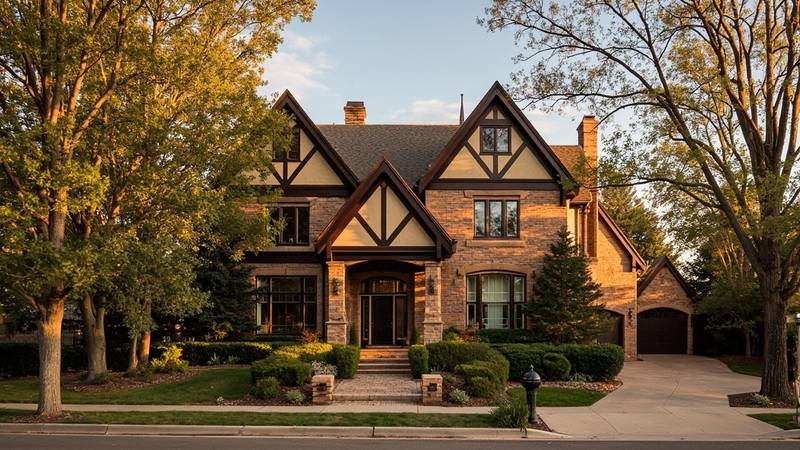
Belcaro is known for its large lots. Many properties sit on a quarter acre or more, which is unusual for a neighborhood this close to Denver’s urban core. The housing stock is predominantly construction from the mid-century era — Tudor, Colonial Revival, and Ranch styles built largely in the 1940s and 1950s — with substantial square footage and the kind of mature tree canopy that takes generations to develop. Homes in Belcaro feel private in a way that most Denver neighborhoods within the city limits simply do not. You have setbacks, yard space, and a genuine separation from the street and from your neighbors.
Bonnie Brae has smaller lots overall, with homes sitting closer together and to the street. The architecture is similarly vintage — bungalows, brick ranches, and Tudor cottages built in the 1920s and 1930s — and the neighborhood has a distinctly charming, residential scale that many buyers find more inviting than imposing. The older construction in Bonnie Brae gives it a particularly dense, established feel, and the homes tend to be on the smaller side relative to Belcaro, though that gap has narrowed considerably as renovation and addition projects have expanded many of the original footprints over the decades.
If you are a buyer who prioritizes privacy, space, and a lot that gives you room to breathe, Belcaro is the stronger fit. If you prefer a neighborhood where homes feel approachable and the residential streets have a genuine community feel, Bonnie Brae often wins that comparison.
Price Points in 2026
Both neighborhoods sit solidly in Denver’s luxury tier, but Belcaro’s larger lots and more substantial homes push its median prices higher.
In Belcaro, homes at the entry level start in the low $1 million range for smaller or unrenovated properties, with most of the market trading between $1.5 million and $3 million for homes that are well maintained, ranging from two thousand to four thousand square feet on generous lots. Exceptional properties on large parcels with full renovations can push above $4 million, and there is a relatively thin supply of listings at any given time — which keeps prices supported and makes relationships built on off-market access meaningful in this neighborhood.
Bonnie Brae has more range. Smaller original homes on the south side of the neighborhood can still be found in the $700,000s to $900,000s, while renovated properties and larger additions reach into the $1.2 million to $2 million range. The commercial strip along South St. Paul Street and the neighborhood’s walkability premium have supported strong appreciation in recent years, and buyers who get into Bonnie Brae below the $1 million threshold on a property with renovation potential often see that investment pay off.
The practical implication: buyers who come to me with budgets in the $1.5 million to $2.5 million range and want to stay within the city limits often look at both. In that range, you can access either neighborhood depending on your priorities, though your options in Belcaro are more limited at the lower end of that window.
The Commercial Strip and Walkability
Bonnie Brae has one amenity that Belcaro does not: a genuine neighborhood commercial strip along South St. Paul Street and East Tennessee Avenue. Bonnie Brae Ice Cream has been a neighborhood institution for decades. Small cafes, restaurants, and boutique businesses line the strip and give the neighborhood a main street quality that Belcaro does not have and, frankly, does not need — because Belcaro’s appeal is rooted in privacy and residential calm rather than walkable retail.
For buyers who want to walk to coffee, lunch, or an ice cream cone without getting in a car, Bonnie Brae wins this comparison by a wide margin. For buyers who prefer that their neighborhood feel exclusively residential — and who can drive five minutes to Cherry Creek for anything they need — Belcaro is the better fit.
Both neighborhoods are easy bicycle commutes to Cherry Creek North, and both connect to the Cherry Creek Trail, which means the regional trail network is accessible without a car for either location. The Washington Park loop, one of Denver’s most popular recreational destinations, is within easy riding distance of both.
Buyer Profile: Who Tends to End Up in Each Neighborhood
After many conversations with buyers considering both neighborhoods, I have noticed some consistent patterns.
Belcaro tends to attract buyers who have owned and loved larger suburban properties and are moving back toward the city but are not willing to give up lot size and privacy. Empty nesters who want walkable access to Cherry Creek without moving into a condo. Buyers who have relocated from cities where established neighborhood feel and mature residential streets are the norm. People who entertain and want a home with genuine outdoor space in a location that does not feel like a subdivision.
Bonnie Brae tends to attract buyers who are drawn to the neighborhood’s scale and charm. Couples and young families who want a walkable neighborhood with community character. Buyers who appreciate older architecture and the aesthetic of a neighborhood that developed organically over a century rather than being planned all at once. People who are comfortable with smaller lot sizes in exchange for the feeling of being genuinely embedded in a neighborhood with history.
There is also an investment angle that surfaces regularly in Bonnie Brae. Because original homes are smaller and renovation potential is real, I work with buyers who are looking for a property where a thoughtful addition and update program can both improve their quality of life and build equity. That play exists in Belcaro too, but the entry price and already substantial square footage make the math slightly different.
Schools
Both neighborhoods are within Denver Public Schools, which means the school assignment landscape is more complex than in Cherry Creek or Douglas County. DPS uses a choice enrollment system, and neighborhood boundaries do not always determine where a child attends school. Buyers with children of school age should research current DPS boundary maps and choice enrollment timelines carefully before purchasing in either neighborhood — and should not assume a specific school assignment based on address alone.
That said, both neighborhoods have historically been associated with strong DPS schools, and the proximity to several of Denver’s most established private schools — including Denver Academy, Graland Country Day, and Kent Denver, among others — makes either neighborhood a reasonable base for families who plan to pursue private education.
The Honest Comparison
Belcaro and Bonnie Brae are both exceptional choices for buyers who want to live within Denver’s city limits in a neighborhood with genuine character and history. The choice comes down to what you are optimizing for.
Choose Belcaro if: you want larger lots, more privacy, substantial square footage, and the feel of a neighborhood where homes sit back from the street and the residential character is uninterrupted. You are willing to pay a premium for that and comfortable with a neighborhood where listings are infrequent and competition for homes priced well is real.
Choose Bonnie Brae if: you want neighborhood charm, walkability to a local commercial strip, the aesthetic of older bungalow and Tudor architecture, and slightly more accessible price points at the entry level. You are comfortable with smaller lots and closer neighbors in exchange for community feel and a location that has only appreciated in desirability over time.
Both neighborhoods have limited inventory and strong appreciation histories over the long term. Neither is a wrong answer. The question is which trade off fits how you actually live.
If you are evaluating either neighborhood and want a conversation about what is currently available, what has sold recently, and where the value sits right now, I am happy to walk through it with you. Reach out here — this is exactly the kind of comparison I do regularly with buyers who are serious about getting it right.
Related Articles
- What Makes Cherry Creek One of Denver’s Most Desirable Neighborhoods
- Cherry Hills Village vs. Greenwood Village: Which Is Right for You?
- What to Expect When Buying a Luxury Home in Denver
- How to Choose a Real Estate Agent in Denver
Is Belcaro or Bonnie Brae more expensive?
Belcaro tends to be more expensive overall, with most homes trading between $1.5 million and $3 million in 2026. Bonnie Brae has more range, with homes at the entry level in the $700,000s to $900,000s and renovated properties reaching $1.2 million to $2 million. The price difference reflects Belcaro’s larger lots and more substantial square footage.
Which neighborhood is more walkable — Belcaro or Bonnie Brae?
Bonnie Brae is more walkable, with a neighborhood commercial strip along South St. Paul Street featuring restaurants, cafes, and Bonnie Brae Ice Cream. Belcaro is a quieter, more exclusively residential neighborhood — you drive to Cherry Creek for retail and dining rather than walking from your front door.
What are the lot sizes like in Belcaro vs. Bonnie Brae?
Belcaro is known for its large lots — many a quarter acre or more — which is unusual this close to Denver’s urban core. Bonnie Brae has smaller lots with homes closer together and to the street, reflecting its 1920s and 1930s development era. Buyers who prioritize outdoor space and privacy typically prefer Belcaro; buyers who prefer neighborhood intimacy often prefer Bonnie Brae.
Are there good schools near Belcaro and Bonnie Brae?
Both neighborhoods are within Denver Public Schools, which uses a choice enrollment system. School assignments are not guaranteed by address, so families with children of school age should research current DPS enrollment timelines directly. Both neighborhoods are also close to several well regarded private schools, including Graland Country Day and Kent Denver.
{“@context”:”https:\/\/schema.org”,”@type”:”FAQPage”,”mainEntity”:[{“@type”:”Question”,”name”:”Is Belcaro or Bonnie Brae more expensive?”,”acceptedAnswer”:{“@type”:”Answer”,”text”:”Belcaro tends to be more expensive overall, with most homes trading between $1.5 million and $3 million in 2026. Bonnie Brae has more range, with homes at the entry level in the $700,000s to $900,000s and renovated properties reaching $1.2 million to $2 million. The price difference reflects Belcaro’s larger lots and more substantial square footage.”}},{“@type”:”Question”,”name”:”Which neighborhood is more walkable — Belcaro or Bonnie Brae?”,”acceptedAnswer”:{“@type”:”Answer”,”text”:”Bonnie Brae is more walkable, with a neighborhood commercial strip along South St. Paul Street featuring restaurants, cafes, and Bonnie Brae Ice Cream. Belcaro is a quieter, more exclusively residential neighborhood — you drive to Cherry Creek for retail and dining rather than walking from your front door.”}},{“@type”:”Question”,”name”:”What are the lot sizes like in Belcaro vs. Bonnie Brae?”,”acceptedAnswer”:{“@type”:”Answer”,”text”:”Belcaro is known for its large lots — many a quarter acre or more — which is unusual this close to Denver’s urban core. Bonnie Brae has smaller lots with homes closer together and to the street, reflecting its 1920s and 1930s development era. Buyers who prioritize outdoor space and privacy typically prefer Belcaro; buyers who prefer neighborhood intimacy often prefer Bonnie Brae.”}},{“@type”:”Question”,”name”:”Are there good schools near Belcaro and Bonnie Brae?”,”acceptedAnswer”:{“@type”:”Answer”,”text”:”Both neighborhoods are within Denver Public Schools, which uses a choice enrollment system. School assignments are not guaranteed by address, so families with children of school age should research current DPS enrollment timelines directly. Both neighborhoods are also close to several well regarded private schools, including Graland Country Day and Kent Denver.”}}]}

Sara Garza
Global Real Estate Advisor · LIV Sotheby’s International Realty
Two decades in luxury real estate, a deliberately limited client list, and a reputation built on patience, candor, and care. More about Sara
Wondering What This Means for Your Move?
Sara reads this market every day. Ask her directly — no pressure, just a straight answer.
Ask Sara(720) 499-4937