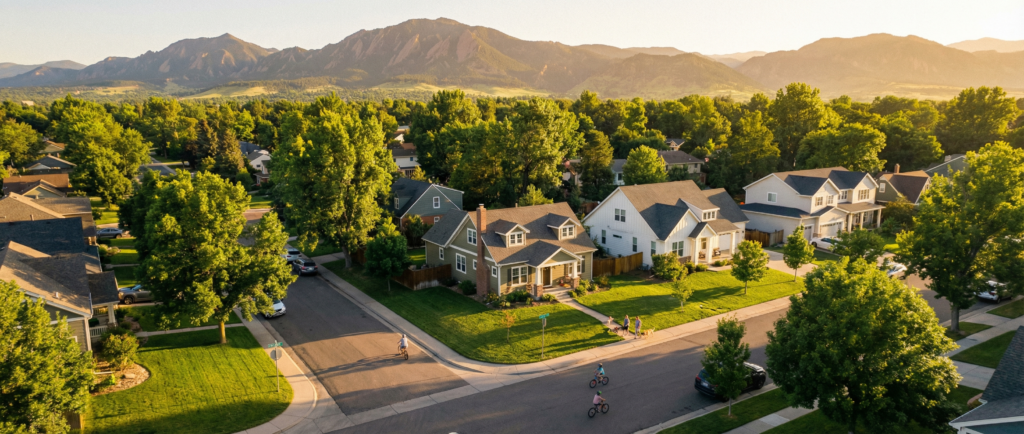
I’ve worked with relocating families for over 20 years, and the same questions come up every time: Where should we live? How are the schools? Will we miss our old city? This guide covers all of it — not the sanitized chamber-of-commerce version, but what I actually tell my clients when they’re deciding whether South Denver is the right fit.
What “South Denver” actually means (because it confuses everyone)
Let me clear this up right away, because even people who live in Denver get it wrong. “South Denver” is not a neighborhood. It’s an informal name for a collection of independent cities and suburbs stretching south from Denver’s city limits along the I-25 corridor.
When people say South Denver, they’re usually talking about:
- Greenwood Village — a city of about 16,000 people. Home to the Denver Tech Center (DTC), top-rated schools in the Cherry Creek School District, and homes ranging from $600K townhomes to $5M+ estates. My office with LIV Sotheby’s is here, so I know it well.
- Cherry Hills Village — one of the wealthiest cities in Colorado. The average lot size is over 2.5 acres. Median home prices run above $2M. Very quiet, very private, and very specific about who it attracts. If you want acreage and horses 15 minutes from downtown Denver, this is it.
- Centennial — a city of roughly 110,000 people. More affordable than its neighbors to the north, with good schools split between Cherry Creek and Littleton school districts. Families from Texas and the Midwest tend to gravitate here because the housing stock feels familiar — newer construction, cul-de-sacs, community pools.
- Castle Pines — a smaller city farther south in Douglas County. Known for gated communities, golf courses, and a slower pace. If you’re coming from a suburban area and want space without the density, Castle Pines is worth a look. More on that in our guide to gated communities in Castle Pines.
- Englewood — a smaller city directly south of Denver, often overlooked. It has more of an urban feel than the others, with a charming old downtown along South Broadway and some genuinely interesting mid-century architecture. See the Arapahoe Acres mid-century modern guide if that’s your thing.
- Highlands Ranch — technically an unincorporated community in Douglas County, not a city. About 100,000 people. Very planned, very organized, tons of trails and recreation centers. The Douglas County School District is consistently rated one of the best in the state.
One critical distinction: these are separate cities, not neighborhoods within Denver. They have their own governments, their own zoning, and often their own school districts. That matters for taxes, for schools, and for understanding what you’re actually buying into.
Schools: the real reason families choose South Denver
I’m going to be direct — schools are the number one reason families relocate to South Denver over anywhere else in the metro area. Not downtown Denver, not the northern suburbs, not Boulder. South Denver, specifically because of two school districts.
Cherry Creek School District covers Greenwood Village, parts of Centennial, and Cherry Hills Village. It’s one of the largest districts in Colorado with about 55,000 students, and it consistently ranks in the top 5 statewide. Cherry Creek High School has an International Baccalaureate program. Campus Middle School in Greenwood Village is a magnet that families literally move to be near. The district spends more per student than the state average and has a graduation rate above 90%.
Douglas County School District covers Castle Pines, Highlands Ranch, and the southern portions of the area. It competes with Cherry Creek for the top spot in state rankings and has a strong STEM focus. Rock Canyon High School and ThunderRidge High School are both well-regarded.
Littleton Public Schools covers parts of Centennial and Englewood. Smaller than the other two, but Heritage High School and Arapahoe High School both perform well.
For private schools, there are several options nearby: Kent Denver School in Cherry Hills Village (one of the most selective in the state), Colorado Academy in southwest Denver, and Valor Christian High School in Highlands Ranch. I’ve helped families who specifically chose Cherry Hills Village just to be in the Kent Denver feeder area. For a deeper breakdown, see our South Denver schools guide.
Here’s what I tell clients coming from states like California, where the school situation is more variable: in South Denver, you don’t have to choose between a good neighborhood and a good school. They tend to come together. That doesn’t mean every school is perfect — Cherry Creek has dealt with overcrowding in some areas, and Douglas County has had its share of political fights over curriculum. But the baseline quality is high.
What homes actually cost here (the honest numbers)
Pricing in South Denver depends enormously on which city you’re in. Here’s what I’m seeing as of early 2026:
Cherry Hills Village: Median sale price is above $2.2M. Most homes sit on 1-3 acre lots. You’re buying land as much as a house. Teardowns on good lots still go for $1.2M+. If you want a full breakdown, read my Cherry Hills Village buying guide.
Greenwood Village: Median around $1.1M, but the range is wide. Townhomes in the DTC area start around $500K. Single-family homes in the Homestead or Heritage neighborhoods run $800K to $2M+. Larger estates near Belleview and University can exceed $3M. I covered this in more detail in the Cherry Hills Village vs. Greenwood Village comparison.
Centennial: Median around $625K. This is where you get the most house for your money in South Denver. Newer construction from the 1990s and 2000s, 4-5 bedrooms, finished basements, attached garages. If you’re coming from a high-cost market like San Francisco or Seattle, you’ll feel like you’re getting a deal.
Castle Pines: Median around $900K. The gated communities like Castle Pines Village run higher — $1.2M to $3M+ depending on the lot and golf course proximity.
Highlands Ranch: Median around $650K. Solid mid-range suburban housing. Lots of inventory in the $500K-$800K range.
Englewood: Median around $500K. The most affordable option. Smaller lots, older homes, but a growing restaurant scene and good light rail access.
A few things to keep in mind about pricing: Colorado doesn’t have a homestead exemption like Texas or Florida. Property taxes are relatively low compared to many states (roughly 0.5%-0.7% of assessed value), but they went up after the 2023 Proposition HH failure and subsequent legislative changes. Budget for property taxes that may increase, especially in Arapahoe and Douglas counties. You can dig into the Douglas County vs. Arapahoe County property tax comparison for more detail.
Commute and transportation (the I-25 question)
If you’re relocating for work, there’s a good chance your office is in the Denver Tech Center, downtown Denver, or one of the office parks along the I-25 corridor. Here’s the reality.
DTC commute: If you live in Greenwood Village, Centennial, or Highlands Ranch, your commute to the DTC is 10-20 minutes. This is the easiest commute situation in South Denver, and it’s why so many corporate relocations land here.
Downtown Denver commute: This is where it gets complicated. I-25 northbound in the morning is the most congested stretch of highway in Colorado. From Centennial to downtown is about 15 miles, but it can take 45-60 minutes during rush hour. From Castle Pines, add another 15-20 minutes.
The RTD light rail (E, F, and H lines) runs through South Denver with stations at Belleview, Orchard, Arapahoe, Dry Creek, County Line, and Lincoln. If you live within a mile or two of a station, the train to downtown takes about 35 minutes and it’s consistent — no traffic variability. I’ve had clients choose homes specifically for light rail proximity. It’s a genuine quality-of-life factor.
Airport commute: DIA (Denver International Airport) is about 35-45 minutes from South Denver without traffic, an hour or more with it. There’s no direct rail from South Denver to the airport — you’d take the light rail downtown and transfer to the A Line. Most people just drive or use a car service.
One thing that surprises out-of-state buyers: Denver’s traffic has gotten noticeably worse over the last decade. We added about 100,000 people to the metro area between 2015 and 2025, and the highway infrastructure hasn’t kept up. If you’re coming from LA or Houston, you’ll think our traffic is fine. If you’re coming from a mid-size city, you might be caught off guard.
The lifestyle adjustment: what people love and what they miss
I’ve helped hundreds of families relocate to South Denver, and the pattern is consistent. Here’s what I hear after the first year.
What they love:
- The weather. Colorado gets over 300 days of sunshine per year. Yes, it snows, but it’s dry snow that often melts within 24-48 hours. If you’re coming from the Pacific Northwest or the Midwest, the sunshine is life-changing. January days in the 50s happen regularly.
- The outdoor access. Within an hour of South Denver, you can be hiking in the foothills, skiing at one of a dozen resorts, or mountain biking in actual mountains. Chatfield State Park and Cherry Creek State Park are right in the area for closer recreation. See our South Denver hiking trails guide.
- The space. Homes are bigger, lots are bigger, and you can afford more here than in coastal cities. A $1.2M home in Greenwood Village would cost $3M in Palo Alto or $2.5M in Westchester County.
- The people. Denver is full of transplants. You won’t be the only new family. There’s less of the “insider vs. outsider” dynamic you’d find in some cities.
What they miss or find frustrating:
- The food scene. Denver has gotten much better over the past decade, but if you’re coming from New York, Chicago, or the Bay Area, you’ll notice the difference. South Denver specifically has more chains than independents, though downtown Denver and neighborhoods like Cherry Creek are a different story. The South Denver restaurant guide has the best local options.
- The dryness. The altitude (5,280 feet and higher) and low humidity are tough on skin, sinuses, and hangovers. Everyone talks about drinking more water, and they’re right. Your first winter, your knuckles will crack and your lips will split. It gets better as you acclimate.
- The sprawl. South Denver is car-dependent. Outside of the light rail corridor, public transit is limited. If you’re coming from a walkable city, this is an adjustment. Greenwood Village and Cherry Hills Village have almost no commercial walkability.
- The distance from family. This one’s obvious, but it hits harder than people expect. Denver is far from everywhere. Flights to the East Coast are 3.5-4 hours. To California, 2.5-3 hours. If your parents are aging and you’re moving here from the Midwest, the distance matters.
How to actually buy a home here from out of state
The logistics of buying while relocating deserve their own section, because I’ve watched too many families make avoidable mistakes.
Step 1: Get pre-approved with a Colorado lender before you visit. Out-of-state pre-approval letters carry less weight with listing agents here. I recommend working with a lender who knows the South Denver market and can speak to local conditions. If you’re buying above $1M, you’ll need a jumbo loan, and those have different requirements — higher down payments (typically 20% minimum), more documentation, and longer processing times. My buyer’s guide for homes over $1 million covers the financial details.
Step 2: Come for a focused scouting trip. I typically schedule these over a long weekend. Day one, we drive the areas — Greenwood Village, Cherry Hills Village, Centennial, Castle Pines — so you can feel the differences. Day two, we tour homes. Day three, we see schools, grocery stores, gyms, the stuff that makes up your daily life. Don’t try to do this over Zoom. You need to feel the altitude, see the distances, and understand the light. Denver light at 5,280 feet looks different than sea level.
Step 3: Be ready to move fast. The South Denver market, particularly in the $600K-$1.2M range, moves quickly in spring and summer. Homes that are priced right and show well go under contract within a week. If you find something you love during your scouting trip, be prepared to write an offer that day.
Step 4: Plan your move timeline carefully. Colorado has a standard closing period of about 30-45 days. If you need to sell a home in another state first, you have a few options: a contingent offer (weaker in competitive situations), a bridge loan, or selling first and renting temporarily. I’ve seen families rent in Denver for 3-6 months to get to know the area before buying, and that approach works well if your employer’s relocation package supports it.
Step 5: Budget for the transition costs. Beyond the home purchase, budget for things like: Colorado driver’s license (required within 30 days of establishing residency), vehicle registration (Colorado’s vehicle registration fees are higher than most states — you’ll pay based on the car’s value), new utility deposits, and potentially higher homeowner’s insurance if you’re in a wildfire-adjacent area like Castle Pines.
For families coming from specific states, we also have guides on moving from California and moving from Texas on our sister site.
The tax situation (better than you think, with caveats)
One of the first questions I get from out-of-state buyers is about taxes. Here’s the breakdown.
State income tax: Colorado has a flat 4.4% income tax rate. If you’re coming from California (13.3% top rate), New York (10.9%), or even Illinois (4.95%), you’ll see a reduction. If you’re coming from Texas, Florida, or Washington — states with no income tax — this is a new cost. It’s not nothing, but it’s lower than most states.
Property taxes: Historically very low in Colorado. The assessment rate for residential property was 6.765% in 2024, applied to a fraction of your home’s market value. On a $1M home, you might pay around $5,000-$7,000 per year in property taxes. Compare that to Texas, where the same home might cost $20,000-$25,000 per year. However, the Gallagher Amendment was repealed, and assessments have been increasing. This is a trend to watch.
Sales tax: This varies by city. In Greenwood Village, the combined state, county, and city rate is around 8%. In Centennial, closer to 8.5%. It’s comparable to most states except Oregon (no sales tax) and lower than many urban areas.
TABOR: Colorado has the Taxpayer’s Bill of Rights, which requires voter approval for tax increases. This is unique and has real implications — it limits government revenue, which affects road maintenance, schools, and public services. You’ll hear a lot about TABOR once you move here.
Frequently asked questions
Is South Denver a good place to raise a family?
Yes. The combination of top-rated schools in the Cherry Creek and Douglas County school districts, low crime rates, access to outdoor recreation, and spacious housing makes South Denver one of the best family markets along the Front Range. Most families I work with are specifically relocating here for the quality of life.
How much does it cost to live in South Denver compared to California or New York?
Overall cost of living is 15-25% lower than the Bay Area and 20-30% lower than metro New York, with housing being the biggest savings. A 4-bedroom home in Centennial ($600K-$750K) would cost $1.5M+ in most Bay Area suburbs. Groceries and utilities are comparable; state income taxes are lower than both California and New York.
What’s the best city in South Denver for families with young children?
Centennial and Greenwood Village are the most popular with young families. Centennial offers more home for the money, while Greenwood Village gives you Cherry Creek School District’s best elementary schools and shorter commutes to the DTC. Castle Pines is excellent if you want more space and a quieter environment.
Do I need a car in South Denver?
Yes. While the light rail connects some areas to downtown Denver and the DTC, South Denver is car-dependent for daily errands, school drop-offs, and most activities. Plan on two cars per household.
How does the altitude affect daily life?
Most people adjust within 2-4 weeks. You’ll get winded more easily at first, especially during exercise. Drink more water, limit alcohol your first week, and use moisturizer. The altitude also means food cooks differently — water boils at a lower temperature, and baking requires adjustments. It’s a real thing, not just a tourist warning.
When is the best time to buy a home in South Denver?
Inventory is highest from April through August. Prices tend to be slightly lower in October through January when fewer buyers are competing. For the best selection, start looking in late February or early March when the spring market begins. In the luxury segment above $1.5M, timing matters less — high-end buyers and sellers operate year-round.
Ready to make the move?
Relocating from out of state is a big decision, and there’s a lot to get right. I’ve helped families move to South Denver from 30+ states over the past two decades, and the process is always smoother when you have someone local who knows these cities, knows which streets flood, which HOAs are strict, and which “great deals” are actually money pits.
If you’re considering South Denver, I’d love to talk through your options. Reach out to me, Sara Garza, at saragarza.com/contact or call my office at LIV Sotheby’s International Realty in Greenwood Village. No pressure, no sales pitch — just honest answers from someone who’s spent her career in these communities.

Sara Garza
Global Real Estate Advisor · LIV Sotheby’s International Realty
Two decades in luxury real estate, a deliberately limited client list, and a reputation built on patience, candor, and care. More about Sara
Wondering What This Means for Your Move?
Sara reads this market every day. Ask her directly — no pressure, just a straight answer.
Ask Sara(720) 499-4937