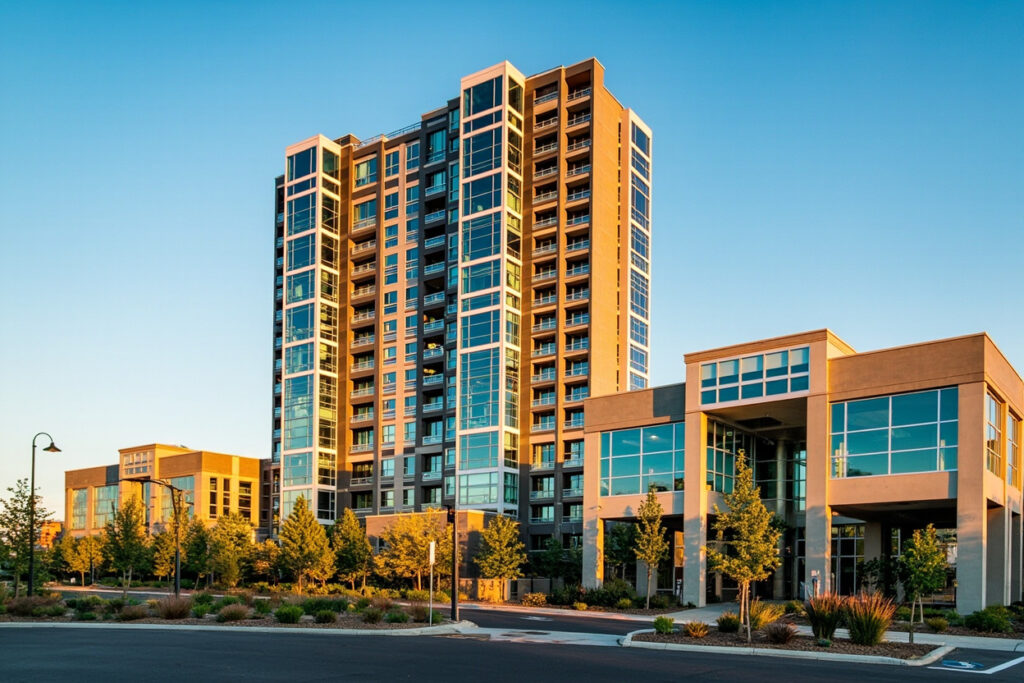
Is buying a home better than renting a luxury apartment in Denver for high-income professionals?
For buyers already spending $8,000/month on a luxury rental, the math almost always favors buying in Denver’s ownership market — a comparable mortgage payment in today’s rates typically qualifies buyers for homes in the $1.4–$1.7M range in desirable South Denver neighborhoods. The switch from rent to ownership builds equity rather than paying an landlord, and the tax advantages of mortgage interest make the effective cost gap wider than it first appears.
Every few months, I get a call from someone who just relocated to Denver for a finance or tech role. They have a budget that sounds comfortable on paper, and they’ve been apartment hunting in the luxury segment. By the time we talk, they’ve usually already figured out that luxury apartments in Denver run $5,000 to $10,000 a month depending on the neighborhood, and they’re starting to wonder whether they’re throwing money away on rent or whether buying in this market actually makes sense.
That’s exactly the question I want to dig into today, because the high end rental market reveals more about the ownership landscape than most buyers realize.
The Denver Luxury Rental Landscape
Denver’s top tier rental buildings cater to a specific kind of buyer: professionals who are here for a defined chapter, remote workers who split time between cities, and executives who want flexibility before committing to a neighborhood. The buildings that command the highest rents tend to cluster around Cherry Creek, the Denver Tech Center corridor, and downtown’s newer high-rises.
A luxury apartment in those buildings, with high ceilings, concierge service, rooftop amenities, and a prime address, will commonly run $7,000 to $12,000 per month. Some of the ultra-premium units, particularly those with mountain views or private terraces in the newest developments, push well beyond that. The residents in those buildings are not hurting for money, but many of them are actively choosing the rental lifestyle precisely because they are weighing the ownership question at the same time.
The pattern I see over and over is this: someone budgets for $8,000 a month in rent, decides that’s their comfort zone, and then starts comparing that number against what they could own. That math is where things gets interesting.
The Ownership Math at $8,000 Per Month
When a lender looks at a buyer who is comfortably affording $8,000 in monthly rent, they see a financial profile that qualifies for a much more substantial mortgage than most people assume. A payment that size, at today’s interest rates, typically corresponds to a purchase price somewhere in the $1.2 million to $1.8 million range depending on down payment, credit profile, and other factors. That opens up an entirely different tier of the Denver market.
Here is what that financial profile actually means on the ground. At $8,000 a month equivalent, a buyer in today’s Denver market can realistically look at single family homes in the $1.4 million to $1.7 million range, or luxury townhomes and paired homes in highly desirable South Denver neighborhoods. The monthly payment may look comparable to what they are paying in rent, but the equity dynamics are completely different.
Every mortgage payment on a owned property builds equity in an asset that historically appreciates over time. Rent, no matter how high the building’s amenities, is a pure expense. The tax advantages of mortgage interest and property ownership shift the effective cost gap even further in favor of buying for someone who plans to stay in Denver for three or more years.
Cherry Creek vs. Bonnie Brae: Two Roads to Ownership
When I work with buyers who are making this transition, two neighborhoods come up most frequently as destinations: Cherry Creek and Bonnie Brae. Both are sought after, both have distinct characters, and both offer something different depending on what the buyer values most.
Cherry Creek, particularly the residential streets just off of the shopping district, offers the convenience of an urban lifestyle with the feel of a tight knit community. Homes there are maintained to a high standard and remain highly desirable, though inventory is limited and competition among buyers is steady. [LINK: \/cherry-creek-denver-desirable-neighborhood\/]
Bonnie Brae, tucked just south of Cherry Creek, has a more established, residential character. The homes tend to be a mix of mid-century bungalows and newer custom builds, and the neighborhood has a quiet authenticity that appeals to buyers who want to feel genuinely rooted in Denver rather than just passing through its amenities. Bonnie Brae properties trade less frequently, which means inventory is scarce when demand picks up, but the neighborhood rewards buyers who find the right property.
For the relocated executive who is comparing luxury apartments in Denver against ownership, the Cherry Creek market typically catches their eye first because it is more familiar from their apartment search. Bonnie Brae requires a slightly different mindset, a willingness to prioritize character and community over the glossy new construction feel of some of the newer buildings. Both are excellent long-term holds in Denver’s real estate landscape.
What Relocated Executives Actually Choose
After twenty years across South Denver’s most sought after neighborhoods, I have worked with enough relocations to have seen the full range of decisions that people make when they reach this fork in the road.
Some of them buy immediately. They run the numbers, realize they are already spending at an ownership-equivalent level in rent, and decide they would rather build equity in a neighborhood they love than continue paying top dollar for a building they will eventually leave. These buyers tend to prioritize Cherry Creek or one of the surrounding South Denver neighborhoods, and they often close within 60 to 90 days of starting their search.
Others choose to rent for one more year, sometimes two. They want to spend a full calendar year in Denver before committing to a specific neighborhood, and honestly, that is a reasonable approach for someone who does not yet know whether they prefer the energy of Cherry Creek or the quiet of Bonnie Brae or one of the nearby enclaves. The cost of that additional year of renting is real, but so is the value of making an informed geographic decision.
A smaller group decides that the rental lifestyle suits them long-term. They value the flexibility, the lack of maintenance responsibility, and the ability to move without the friction of selling. For those buyers, I make sure they are renting in a building that at least builds equity indirectly through a landlord who is managing the asset responsibly. Not all luxury apartment buildings are created equal from an investment perspective.
The thread that connects all of these choices is the same: the high end rental market is giving you a free market signal. If you are comfortably paying $8,000 a month for a luxury apartment in Denver, you are already qualified to own something meaningful in the same city. The question is not whether you can afford it. The question is whether you are ready to commit to a neighborhood and a lifestyle that ownership requires.
If you are in that position and want to explore what ownership looks like in Cherry Creek, Bonnie Brae, or another South Denver neighborhood, I would love to talk through the specifics of your situation. [LINK: \/contact\/]

Sara Garza
Global Real Estate Advisor · LIV Sotheby’s International Realty
Two decades in luxury real estate, a deliberately limited client list, and a reputation built on patience, candor, and care. More about Sara
Wondering What This Means for Your Move?
Sara reads this market every day. Ask her directly — no pressure, just a straight answer.
Ask Sara(720) 499-4937